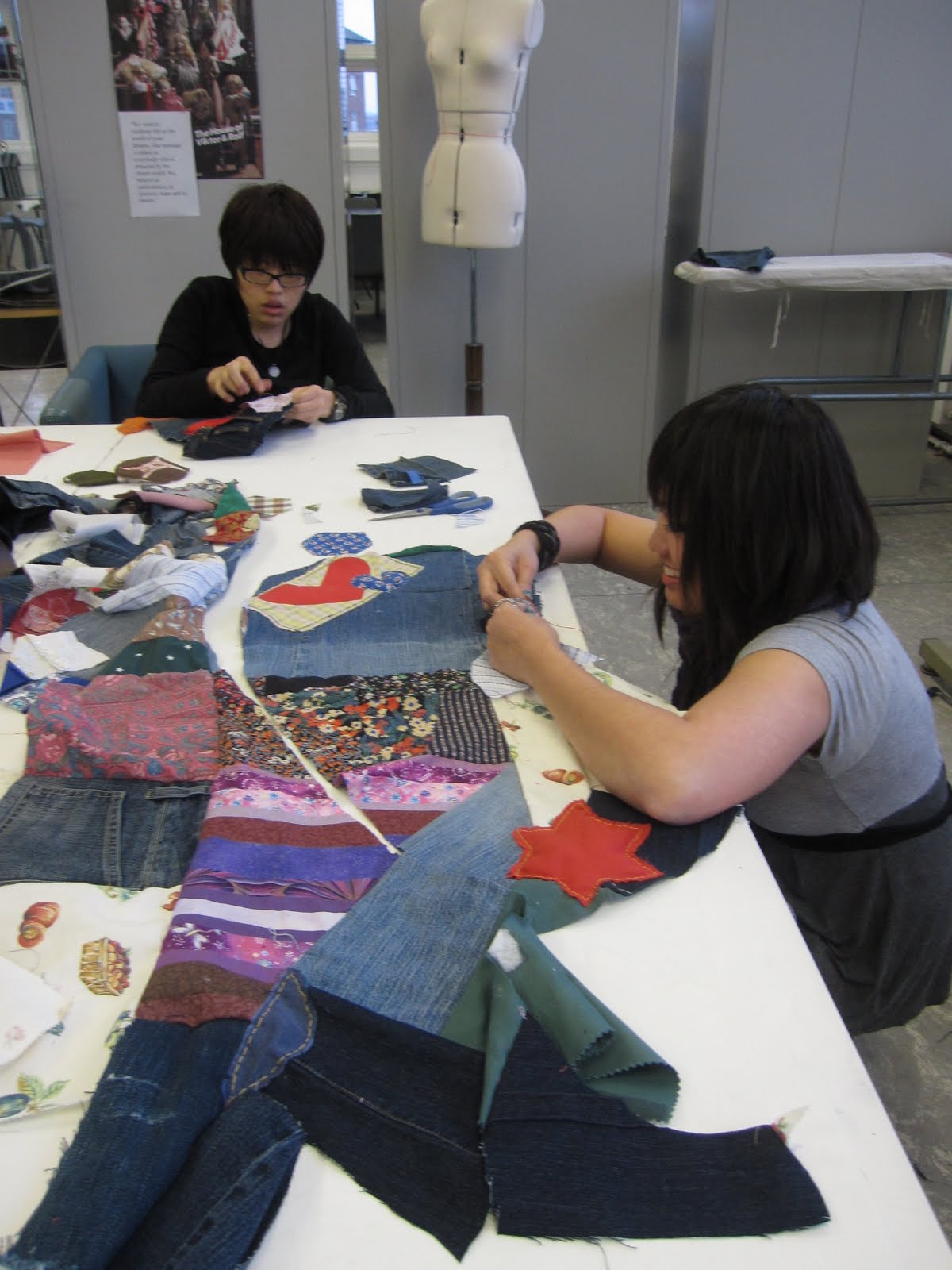
Ever since the durable, everlasting, live-in fabric called “Denim” was invented, its been used for all things fashion- jeans, jackets, bags, purses, shoes, head gear.. The list goes on and on. So when the “Denim- Image and Identity” project was popped to us, we (all the collective nouns read Astri Sefrina, Chanita Theeradej, Chiung-Yu Li, Naranya Taechavorawongsa and Madhumitha Rathnasekar) jumped, squealed (at the prospect of working together on a project) and promptly rose to the occasion with our very own, distinctive take on denim.
We relate Urban Outfitters to everything, trendy, vintage and high-street and therefore came up with the idea of making a stuffed doll, patch worked with bits and pieces of denim and vintage-y fabrics, that we collected by scouring all the bins at Birmingham Institute of Art & Design (the place that encourages our creative talents). Through this, we intended to spread the message of endearing, fun on one hand and the more serious but equally cool issue of recyclable fashion on the other. We started off by deciding on making a stuffed bunny, rather than a teddy or a pig, as the first was way too commonplace and the latter nobody would want to relate to! Through Coopa, (we named our bunny that!) we spread the message of joy, togetherness (we know Christmas is long gone but the spirit still stays!) and the enjoyment of working as a team, to people all over Birmingham, right from babies to kids to youngsters to the elderly, by bringing amused smiles to their lips.
Carnaby Street is the centre of youth fashion and hosts all the leading denim brands sold worldwide.The exhibition will take place this year and is set to become the event people will talk about. Concerning itself with the past, present and the future of denim, the exhibition will also provide priceless information about future trends, because we will ask tomorrow’s designers, stylists and wearers about their ideas and attitudes.
Why denim? Because denim is cultural phenomena, a fabric and an idea which instigated massive changes in the structure of the fashion industry and continues to lend its magic and to encapsulate the dreams and aspirations of the wearer. Denim has broken through every social barrier, gender, race, and culture. It can be said to have democratised fashion itself. We as individuals are defined by our denims, each brand and model having an identifiable and inbuilt set of values, a personality. Denim has as many facets as a diamond. Denim is worn with confidence and carries with it a set of values recognised wherever it is worn.
What is Denim ID? It is an interactive fashion exhibition where the audience is invited to become part of the exhibition. Fashion, art and street culture will collide and images illustrate the past, present and future of denim.The people who help create the ideas and attitudes which evolve denim will be invited to walk into the exhibition and to look at iconic images created around denim during the last fifty years, but presented in new and exciting ways.The past theme is nostalgic and includes advertising images long forgotten divided into decades of unforgettable advertisements and posters and significant quotes which will provide a hall of fame for denim.Cool Seekers will roam Carnaby Street, capturing today’s images, to join the great images of the past in the exhibition.Tomorrow’s theme The exhibition will have a high interactive element and be designed to encourage and invite ideas and input from people at the cutting edge of fashion – those who have attitude and imagination enough to become tomorrow’s denim enthusiasts. Denim fashions bubble up from the street and these reinventions of denim can be captured in this live event through photography and the involvement of the fashion hungry youth market found on Carnaby Street.Denim prospers, taking on the contours and individuality of the wearer, it promotes universalism whilst at the same time individual expression. Denim is embodied in our society as classless; it is widespread amongst different sub-cultures and mainstream groups. It is worn internationally by the rich and famous to voice a streetwise attitude and paradoxically by the poor, who can bolster their status by wearing the same denim as the rich and famous. It is sexy, rebellious, tough, macho and feminine all at once and embodies values that suit everyone. As the generations have passes this fabric and its messages, became whatever the wearer wished it to be.
Launderette, first shown on Boxing Day 1985, and later Bath which featured a different male model soaking his jeans in the bath while wearing them, aimed to spearhead the company’s recovery. The soundtracks also soared in popularity. In one week in 1986, two Levi’s 501 soundtracks, Ben E King’s Stand by Me and Percy Sledge’s When a Man Loves a Woman were both in the British charts. The all-important 16-24 year old male was the target for the advertisements. The campaign was meticulously planned. In just 12 months after the official re-launch of Levi’s 501 jeans, sales rose by 700%, doubling yet again the year after (Mort, 1996; 12). Sales were staggering, even though 501s were the most expensive jeans Levi’s produced. Factories struggled to cope with the demand, staff worked 12 hour shifts of overtime (Mort, 1996; 12). The basic design dated from 1873 but a TV commercial made 501s essential wear for 1980s Britain, along with boxer shorts, which became indispensable apparel for the new rebel, of whatever age. Levi’s jeans had entered other settings, becoming acceptable for middle-aged men, for example. Nothing distinguished the students from the lecturers when both wore jeans. An existing product, Dockers, was redirected at the older market, leaving 501s as a young person’s jean which could be personalised by shrinking, bleaching of tearing (Myers, 1999). Branding and advertising in the 1980s created the ‘new man’, in touch with his feminine side, The Launderette used shamelessly homoerotic male body-worship imagery, and Kamen became the classic gay icon - the lone hero standing aside from mainstream society and, perhaps, looking down on it a little. “There’s always the sort of circle that goes on, you know we find something incredibly fashionable our kids come along and they want to reject what we do, so there’s a sense of them finding their own identity. Of course what a jeans company has to do is somehow constantly identify with the emerging market, with the emerging teenage market. You’ve got to capture somebody in their youth but once you’ve got into a pair of jeans in your youth you kind of stay with them for the rest of your life because it’s like putting your youth on again. When you’re putting on a pair of jeans you really are putting on your youth. We have a very interesting relationship with jeans, it’s a very kind of deep psychological relationship in terms of what they mean, the fact that the more you were them the better they get. They are very particular to you, how you wear them even though they are all the same. Ostensibly, 5 pocket, Western jean, that’s what they are classically referred to as, but everybody has a sort of relationship with their jeans which is different from everybody else, how you wear them, what you put in the pockets, how the pockets therefore wear, how you rub them, what stage do you wash them, how often do you wash them, so its an incredibly organic product, and therefore your relationship with them is quite deep. So when you’re emerging as a teenager, when you’re emerging into adulthood, putting on your jeans is in a sense putting on your adulthood. That feeling that sense stays with you for the rest of your life. So it’s very important if you’re marketing jeans to market at that emerging market.” (Hegarty Interview) I asked John Hegarty his views on whether The Launderette campaign had given permission to the mass market to wear denim. He replied:
“You’ve touched a nerve, there we had gone through the late 70s and early 80s, we called it the post punk phenomena where really what punk did, it blew all fashion apart. So that there was no fashion and you basically, as soon as something became fashionable it was out of fashion, it was anarchic, it was a completely anarchic period. To a large extent you followed whatever music you were into, you dressed like that particular band so you’d get people who were fans of Dexy’s Midnight Runners they’d be dressed like the band of Dexy’s Midnight Runners or you’d get Boy George fans who were literally dressed the way Boy George was dressed and then you got the new Romantics and all that sort of thing going on. So it was very difficult marketing to that group of people, completely fragmented. And then with the resurgence of people like Wham and bands like that, they began to get a more cohesive fashion look and people wanted a kind of look that they could all join in and everyone could be a part of. And laundrette was the thing that sparked that desire, because we presented a look, a feel, a style, an attitude that suddenly connected with the mid 80’s teenager, and they said that’s cool we can all buy into that, it’s very simple it can just be a T shirt a pair of 501s you can where them anyway you like and all of a sudden fashion became easy again. Whereas before that it was incredibly difficult I mean, God, fashion in north London was different from fashion in South London, what band you were into, what music you listened, where you went to school, where you went to college and it was a completely fragmented market up until that moment”. (Hegarty Interview 2004)